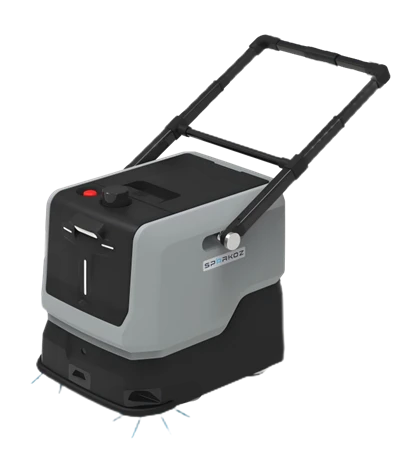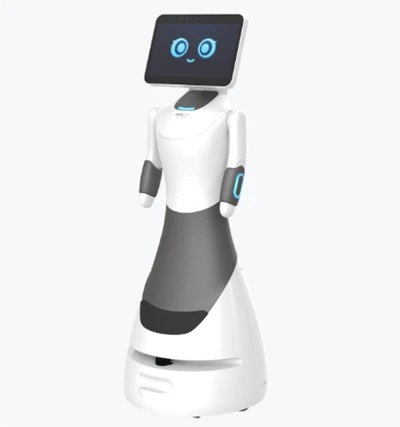


In the rapid evolution of commercial service robots, their forms, functions, and application boundaries are becoming increasingly clear. Different types of robots exhibit significant differences in their service targets, capabilities, and technological paths. Clarifying these differences helps the industry achieve precise matching during selection and deployment, maximizing the application value of robots.
From the perspective of service fields, commercial service robots can be divided into retail-oriented, catering-oriented, hotel and tourism-oriented, and healthcare-oriented categories. Retail-oriented robots focus on customer flow guidance, product consultation, and promotional information broadcasting, emphasizing the breadth of interaction and information update efficiency; catering-oriented robots focus on food delivery, tableware collection, and kitchen collaboration, highlighting load-bearing capacity and path accuracy; hotel and tourism-oriented robots focus on luggage handling, room service, and guided tours, while also considering long battery life and multilingual support; healthcare-oriented robots primarily focus on drug delivery, disinfection and epidemic prevention, and assisted diagnosis, emphasizing aseptic operation and adaptability to high-risk environments. These field differences determine the different orientations of each type of robot in terms of hardware configuration and software logic.
Based on functional complexity, robots can be categorized into single-function and multi-functional hybrid types. Single-function robots have a streamlined structure and controllable cost, specializing in a single high-frequency task, such as fixed-point cleaning or delivery, suitable for scenarios with high process standardization. Multi-functional hybrid robots integrate multiple operational modules, flexibly switching between guidance, transportation, display, and interaction, suitable for commercial complexes with diverse businesses and complex spaces, but placing higher demands on system integration and scheduling algorithms.
Based on interaction methods, robots can be categorized into passive response and proactive service types. Passive response robots rely on user-initiated commands, completing a single task via voice or touch, with short interaction links and simple logic. Proactive service robots possess context awareness and predictive capabilities, proactively providing suggestions or assistance based on customer flow density and time points, such as peak-hour crowd control or departure reminders, placing more stringent requirements on perception algorithms and decision-making models.
Based on mobility, robots can be categorized into fixed-track, wheeled free-movement, and tracked types. Fixed-track robots operate along preset paths, offering stable positioning but limited flexibility, and are often used in factory workshops or warehouse sorting. Wheeled, free-moving robots can maneuver flexibly on open surfaces, adapting to complex pedestrian environments such as shopping malls and restaurants. Tracked robots have strong traction, suitable for ramps, carpets, or uneven surfaces, and are commonly found in outdoor parks or special venues.
From a deployment perspective, they can be divided into standalone independent operation types and cluster collaborative types. Standalone robots are easy to deploy quickly in small-scale scenarios and have low maintenance barriers; cluster robots achieve cross-location collaboration and load balancing through network interconnection and task sharing, suitable for large complexes or multi-story buildings, and require a high-efficiency central scheduling system.
Therefore, the differences between commercial service robots are not only reflected in their external form, but also rooted in the differentiation of their internal capability systems and application logic. Understanding these differences can help practitioners scientifically plan the introduction path based on business pain points and scenario characteristics, promoting robot applications from "usable" to "easy to use" and "durable."