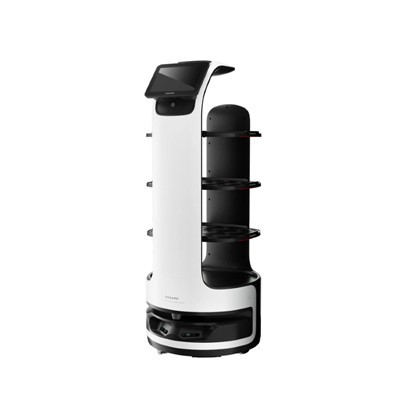


Hey there! As a supplier of robot receptionists, one question I get asked all the time is, "What's the battery life of a robot receptionist?" Well, let's dive right into this topic and break it down.
First off, the battery life of a robot receptionist can vary quite a bit. It depends on several factors, like how the robot is used, its size, the type of battery it has, and the power - consuming components it's equipped with.
Let's start with usage. If a robot receptionist is constantly on the move, greeting visitors, guiding them around, and answering questions non - stop, it's going to drain the battery much faster. Imagine a Reception Robot working at a busy airport or a large corporate lobby. It's likely to be in high - demand mode throughout the day, interacting with tons of people, moving around, and doing other tasks. In such a high - traffic environment, the battery might last anywhere from 4 to 8 hours.
On the other hand, if the robot is placed in a less busy area, like a small office where there are only a few visitors a day, it can conserve a lot of power. It won't have to move around as much or engage in continuous conversations. In this scenario, the battery life can extend up to 12 hours or even more.


The size of the robot also plays a role. Larger robots usually have bigger batteries, which can store more energy. But they also have more components and a larger body to move around, which requires more power. For instance, an Intelligent Humanoid Service Robot with a human - like appearance and complex movements might have a larger battery, but it will consume more energy to operate its motors and sensors for smooth locomotion and interaction. Smaller robots, while having less battery capacity, may use less power overall, so their battery life can still be decent depending on usage.
The type of battery is another crucial factor. Most modern robot receptionists use lithium - ion batteries. These batteries are popular because they have a high energy density, which means they can store a relatively large amount of energy in a small space. They also have a relatively long lifespan and can be recharged many times. However, the quality and capacity of lithium - ion batteries can vary among different models of robot receptionists.
Some high - end robot receptionists come with advanced battery management systems. These systems can optimize the power consumption of the robot. They can adjust the power output based on the tasks the robot is performing. For example, when the robot is in standby mode, the battery management system can reduce the power consumption to a minimum. This helps to extend the overall battery life.
Now, let's talk about the impact of power - consuming components. Robot receptionists are often equipped with a variety of sensors, such as cameras, lidar sensors, and microphones. These sensors are essential for the robot to perceive its environment, recognize faces, and understand voice commands. However, they also consume power. A robot with high - resolution cameras and advanced lidar sensors will use more energy compared to one with basic sensors.
Similarly, the display screen on the robot, if it has one, can be a significant power drain. A large, high - brightness display will require more power to operate. If the robot is constantly showing videos, images, or information on its screen, this will decrease the battery life.
In the Service Robot Industry, manufacturers are always looking for ways to improve battery life. They are researching new battery technologies, more energy - efficient components, and better power management algorithms. For example, some companies are exploring the use of fuel cells in robot receptionists. Fuel cells can provide a continuous source of power and may potentially offer longer operating times.
Another option is to design robots with modular battery systems. This allows the batteries to be easily swapped out when they run low. For a busy establishment, having spare batteries on hand means that the robot receptionist can keep working without long downtimes for charging.
When it comes to specific models of robot receptionists, each one has its own battery life characteristics. Take, for example, our Welcome Robot. It's designed to be energy - efficient while still providing excellent service. Under normal usage conditions, which include moderate interaction with visitors and occasional movement around a lobby, it can operate for about 8 - 10 hours on a single charge.
Our Greeting and Guidance Robot is a bit different. It's more focused on guiding visitors through a large area, which requires more movement. So, its battery life is typically around 6 - 8 hours under normal operation.
If you're considering purchasing a robot receptionist, it's important to think about your specific needs. If you have a large, busy facility, you might want to look for a robot with a longer battery life or a modular battery system. If your needs are more modest, a robot with a shorter but still sufficient battery life might be a better fit for your budget.
At the end of the day, battery life is just one aspect to consider when buying a robot receptionist. You also need to look at factors like the robot's functionality, ease of use, and how well it can interact with your visitors.
If you have any questions about our robot receptionists, including their battery life, or if you're interested in a purchase and want to discuss your specific requirements, don't hesitate to reach out to us. We're here to help you find the perfect robot for your business!
References
- Industry reports on service robot technology and battery development.
- Internal product specifications of our robot receptionist models.